Making a Change
Here's help for customers who are remodeling or making upgrades, conversions, relocations or other changes to existing service.
Examples of adding services to an existing location would include adding metered service to a barn, garage, additional building, or EV charger.
Minnesota Power asks that new electrical loads be served from a single service point whenever possible. If additional service points are requested, the customer is responsible for all costs unless one of the following applies:
- The property is divided by a public road or alley that prevents the customer from distributing their own service.
- Buildings or operations are so geographically separated that it is not electrically feasible for the customer to distribute their own service.
To request an additional service point, fill out the applicable construction request and follow the instructions for submittal.
Residential Construction Request
Commercial Construction Request
If you are interested in finding the average cost for an Additional Metered Service , try our Average Cost Finder.
*Please note: The Average Cost Finder includes historical average pricing that may be helpful in providing a general idea of costs for the services we offer. It is not intended to provide an official estimate.
Electrical Inspection Requirement: In compliance with the Minnesota Electrical Act (Statute 326.244, Subd. 3), Minnesota Power cannot energize any electric service until we receive a Request for Electrical Inspection or confirmation that the inspection has been completed.
When significant changes are being made to an existing service, early communication helps prevent scheduling delays and unnecessary outages. Our team will work with you to determine the best service delivery options and ensure all changes meet Minnesota Power engineering standards and our electric service regulations. Minnesota Power reserves the right to set the point of delivery and collect any costs incurred before the modified service is energized.
Examples of when to work with us:
- Substantial increases in amperage requirements
- Relocation of the service entrance
- Disconnecting the meter
- Changes to the meter location
- Changing from overhead to underground
- Requesting a different phase or voltage
- Installation of Dual Fuel or Fixed Off-Peak equipment
- Installing generation
Relocation of Facilities
A relocation is the adjustment, removal, or rearrangement of electric lines, poles, or equipment. The customer requesting a relocation is responsible for all associated costs. If the relocation alters or disrupts other services, the customer making the request is responsible for the costs associated with any new facilities needed to provide services after the relocation.
To request a relocation, fill out a relocation request (Form 7138) and follow the instructions for submittal.
If you are interested in finding the average cost for any of the services listed above, try our Average Cost Finder.
*Please note: The Average Cost Finder tool includes historical average pricing that may be helpful in providing a general idea of costs for the services we offer. It is not intended to provide an official estimate.
Overhead-to-Underground Conversions
An overhead-to-underground conversion is the process of replacing existing aerial electric lines and equipment with underground cables to enhance reliability and aesthetics. The customer requesting the conversion would pay for all associated costs.
To request an overhead-to-underground conversion, fill out Form 7137 and follow the instructions for submittal.
Service Upgrades
Service upgrades involve increasing a service's electrical capacity by replacing, upgrading, or installing new equipment. Minnesota Power's equipment and facilities used to supply service to a customer have a definite limited capacity. Customers must notify the company and get Minnesota Power's approval before making any material changes or increases in their installation. A Minnesota Power representative will explain the conditions under which service can be provided for the requested change or increase. If changes to Minnesota Power's equipment are needed, the customer is responsible for those costs. If changes are made without Minnesota Power's approval or without any required equipment upgrades, the customer will be responsible for damage to company facilities.
To request or notify us of a service upgrade, fill out the appropriate request form, follow the instructions for submittal and ensure all requirements are met.
Commercial Construction Request
-
Upgrades to a 200-amp service do not require submitting a request if the service is not being relocated, however:
- The meter socket must be upgraded to a 200-amp lever bypass socket.
- A Temporary Disconnect/Reconnect form must be submitted when pulling a meter or de-energizing a service.
If you are interested in finding the average cost for any of the services listed above, try our Average Cost Finder.
*Please note: The Average Cost Finder tool includes historical average pricing that may be helpful in providing a general idea of costs for the services we offer. It is not intended to provide an official estimate.
Physical Disconnection
Customers may need a meter or powerlines physically removed from a property in situations such as a house fire, demolition, or a house move. Once removed, the property will no longer have power to the specific location.
Important information:
- If power is reconnected at this address within 12 months under the same account, monthly minimum meter fees will be billed for that period (up to 12 months).
- If power remains off for more than 12 months, an electrical inspection is required before service can be restored.
- Minnesota Power is not responsible for any property damage resulting from the discontinuation of electric service.
To request a physical meter disconnection, complete the form or call Minnesota Power at 1-800-228-4966.
Request for Physical Disconnect
Temporary disconnections help Minnesota Power and licensed electrical contractors work safely and efficiently. We permit temporary disconnects/reconnects on customer-owned service conductors attached to Minnesota Power overhead service wires when:
- Work is performed by a licensed electrical contractor.
- Service is 120/240V single phase, self-contained, 320 amps or less.
- All work occurs on the customer side of the permanent connectors.
- See Interrupting Power to the Meter below.
Homeowners are not permitted to perform temporary disconnects and reconnects. You must schedule Minnesota Power to perform the temporary disconnect/reconnect.
Note: Fees start at $500 for work performed outside Minnesota Power's normal operating hours (8:00 a.m.–3:30 p.m., excluding holidays). Work is not scheduled on holidays.
-
Minnesota Power requires a lever bypass meter socket for all service upgrade work and new installations—no exceptions. This ensures safe meter testing and future maintenance. A lever bypass socket is also required when performing:
- Overhead-to-underground conversions
- Underground cable replacement from the meter
- Weatherhead/mast replacement
- Service panel replacement (equal or greater amperage)
- Generator installations (permanent backup generator, solar, wind, battery storage, etc.)
Interrupting Power to the Meter
Minnesota Power meters automatically send outage alarms when power is interrupted. If we're not notified and crews are dispatched, the party responsible may be charged for the callout.
If you need to de-energize the service or remove a meter from the socket, you must:

Complete the Temporary Disconnect/Reconnect form and indicate that you will be removing the meter or temporarily disconnecting power. You will need to provide:
- Customer/property owner name
- Service address where work will be performed
- Date of work
- Electrician name, contact number, and license number
- Electrical inspection number

Disconnect only on the customer side of the permanent connectors.

Ensure no load is connected when the meter is removed or reinstalled.

Contact Minnesota Power immediately if any issues arise.
Swing Service (Moving Minnesota Power service wire)
Only Minnesota Power lineworkers may handle or move Minnesota Power overhead service wires. If the attachment point needs to be relocated:
- Install the new attachment point
If the attachment point is changing significantly (10 or more feet), submit a Relocation Request (Form 7138) to work with a Minnesota Power representative to approve the new location. - Call Minnesota Power to schedule an appointment to swing the service wire to the new attachment point.
Clearance Requirements (NESC):
- Over streets, alleys, public roadways, parking lots, commercial/industrial/farm areas: minimum of 16 feet
- Over residential driveways: minimum of 15 feet, 6 inches
Exceptions require Minnesota Power Engineering approval.
Electrical Inspection
Minnesota Power must receive your electrical permit number before scheduling work.
- Send documentation to: inspections@mnpower.com
- Call 218-720-2757 to schedule or if you have questions.
Bypass Metering Requirements:
(If Lot Line Metering is Not Used)
To ensure safety and minimize power interruptions during meter replacement or calibration, Minnesota Power requires customer-owned, self-contained meter sockets to have a jaw-clamping, lever-operated bypass. Horn-type bypasses are not acceptable.
When a Lever Bypass Meter Socket is Required:
- New installations
- Overhead-to-underground conversions
- Underground cable replacement
- Weatherhead/mast replacement
- Service panel upgrades (equal or greater amperage)
- Generation installations (backup generator, solar, wind, battery storage, etc.)
- In cases where power has been off for an extended period of time
Self-Contained Metering Specifications:
- 200-Amp Single-Phase 3-Wire: 4 or 5 terminal, 200-amp, jaw-clamping, lever-operated bypass, weatherproof, ringless, screwless cover, 5th jaw at nine o'clock position, hub opening for overhead, closure plate or plain top for underground.
- 320-Amp Single-Phase 3-Wire: 4 terminal, 320-amp, jaw-clamping, lever-operated bypass, weatherproof, ringless, screwless cover, hub opening for overhead or plain top for underground. Anti-inversion clips in the upper right jaw are not allowed.
- 200-Amp 2 Position Single-Phase 3-Wire: 4 terminal, 200-amp, jaw-clamping, lever-operated bypass per position, weatherproof, ringless, screwless cover, hub opening for overhead or plain top for underground.
Approved Meter Socket Manufacturers:
Examples of UL-approved metering equipment providers include Landis & Gyr, Milbank, T&B, Anchor, Durham, Siemens, Square D, Cutler Hammer, and Midwest Electric.
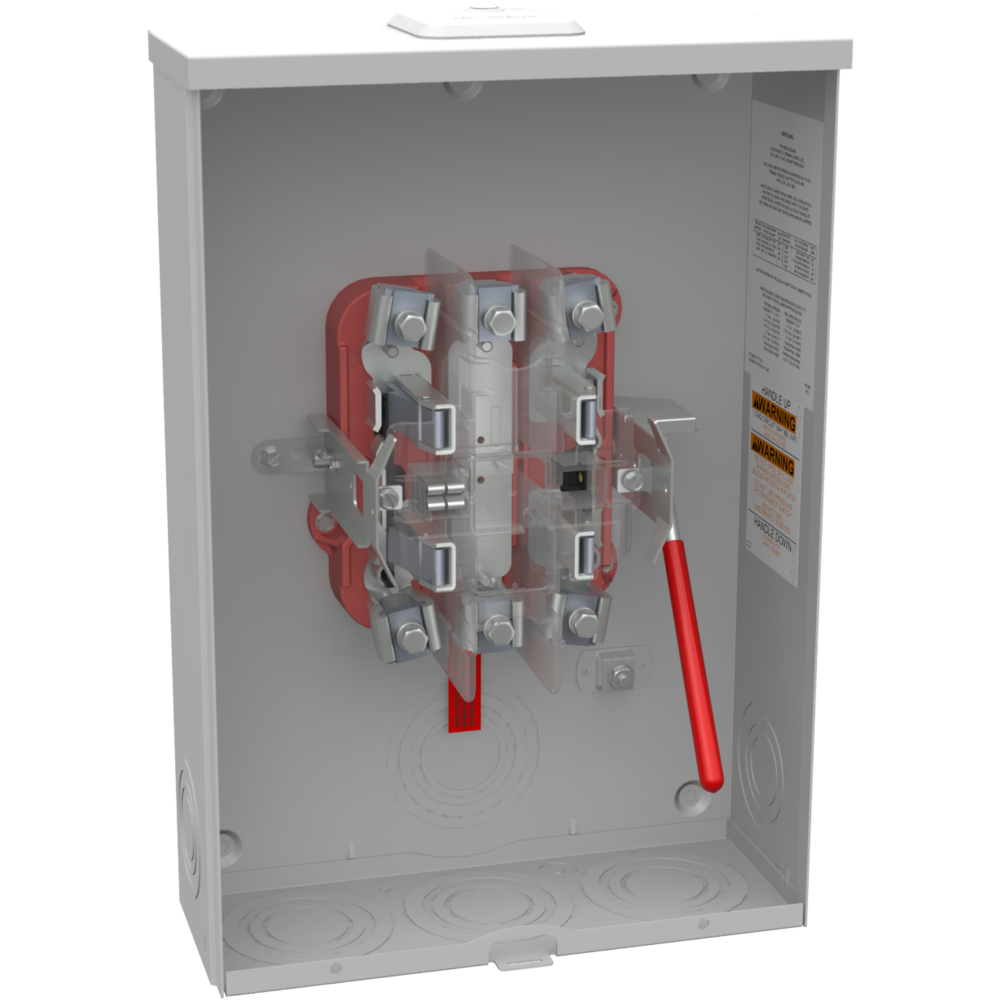
Click image for larger view
Sample Part Numbers
Milbank U-4801-XL-5T9
Siemens Drawing 48804, PN 48804-02NU
Metering services greater than 320A and in excess of 240V require instrument-rated metering equipment.
Meter Location Requirements:
- Outdoor metering is required unless prior approval is given.
- Outdoor installations: Center line of the meter must be 4–6 feet above finished grade.
- Minimum 3 feet of unobstructed space in front of the meter and 12 inches of space on all sides.
Please call Minnesota Power's Meter Department at 1-800-228-4966 for questions regarding sockets.
Your local or state electrical code may have additional requirements.
Temporary Metering Requirements:
Minnesota Power requires bypass meter sockets for temporary service installations.
Questions?
Call us at 1-877-535-0394 or 218-355-2644, or email newconstruction@mnpower.com