Project Center Resources
Everything you need in one place — forms, requirements, and guidance for working with Minnesota Power.
Fix-It Letters notify customers when Minnesota Power identifies a potentially hazardous or unsafe condition on customer-owned equipment. It is the customer's responsibility to correct the issue. If the condition is deemed hazardous, power may be disconnected without notice to protect you, other customers, the public, utility personnel, and utility-owned equipment. If power is not disconnected immediately, you will receive a Fix-It Letter explaining what needs repair.
Work with a licensed electrician, your State Electrical Inspector, or the State's contractor resources to determine repair requirements. Repairs should be completed as soon as possible. If repairs are delayed, Minnesota Power will disconnect service. Stay in contact with Minnesota Power about your repair progress—if you are actively working on a solution and conditions do not worsen, we will work with you on timing deadlines.
Minnesota Power's Fix-It Process
When an unsafe situation is found which does not require immediate disconnection, Minnesota Power will:
- Send a letter explaining terms and conditions to all relevant parties.
- Attempt to keep power on until repairs are completed.
- If repairs are not completed within the specified timeframe, power will be disconnected for safety.
Customers must provide Minnesota Power with the following:
- If required, receipt of your Electrical Inspection ID emailed to inspections@mnpower.com.
- Receipt of your photo proof of repairs emailed to fixit@mnpower.com.
Once required steps are completed, Minnesota Power will reconnect service during normal business hours. After-hours reconnection is available for an additional fee.
Important: Failure to provide the required inspection documentation will not result in an extension of the disconnection schedule.
For questions, contact Minnesota Power at (877) 535-0394 or fixit@mnpower.com.
The chart below shows which requirements apply to different types of repairs.
| Type of Work | 200 amp level bypass required |
Electrical Permit required by Minnesota Power* |
|---|---|---|
| Point-of-Attachment Repair or Replacement | NO | NO |
| Overhead to Underground Conversions | YES | YES |
| Replacement of Privately-Owned Cable on Load Side of Meter (Overhead or Underground) | YES | YES |
| Weatherhead Repair | NO | NO |
| Weatherhead Replacement | NO | YES |
| Mast Repair | NO | NO |
| Mast Replacement | YES | YES |
| Lug Replacement | NO | NO |
| Roofing/Mast Flashing Replacement | NO | NO |
| General Socket or Service Panel Maintenance | NO | NO |
| Replacement of Service Panel (with equal or greater amperage rating) | YES | YES |
| Permanent Generator Installation | YES | YES |
*Governing Authority may require Electrical Permits for repairs or replacements different than this list. Please contact your local electrical inspector to determine if a permit is required.
If the meter socket is on a customer-owned structure for overhead service, the following diagram shows the ownership of the equipment.
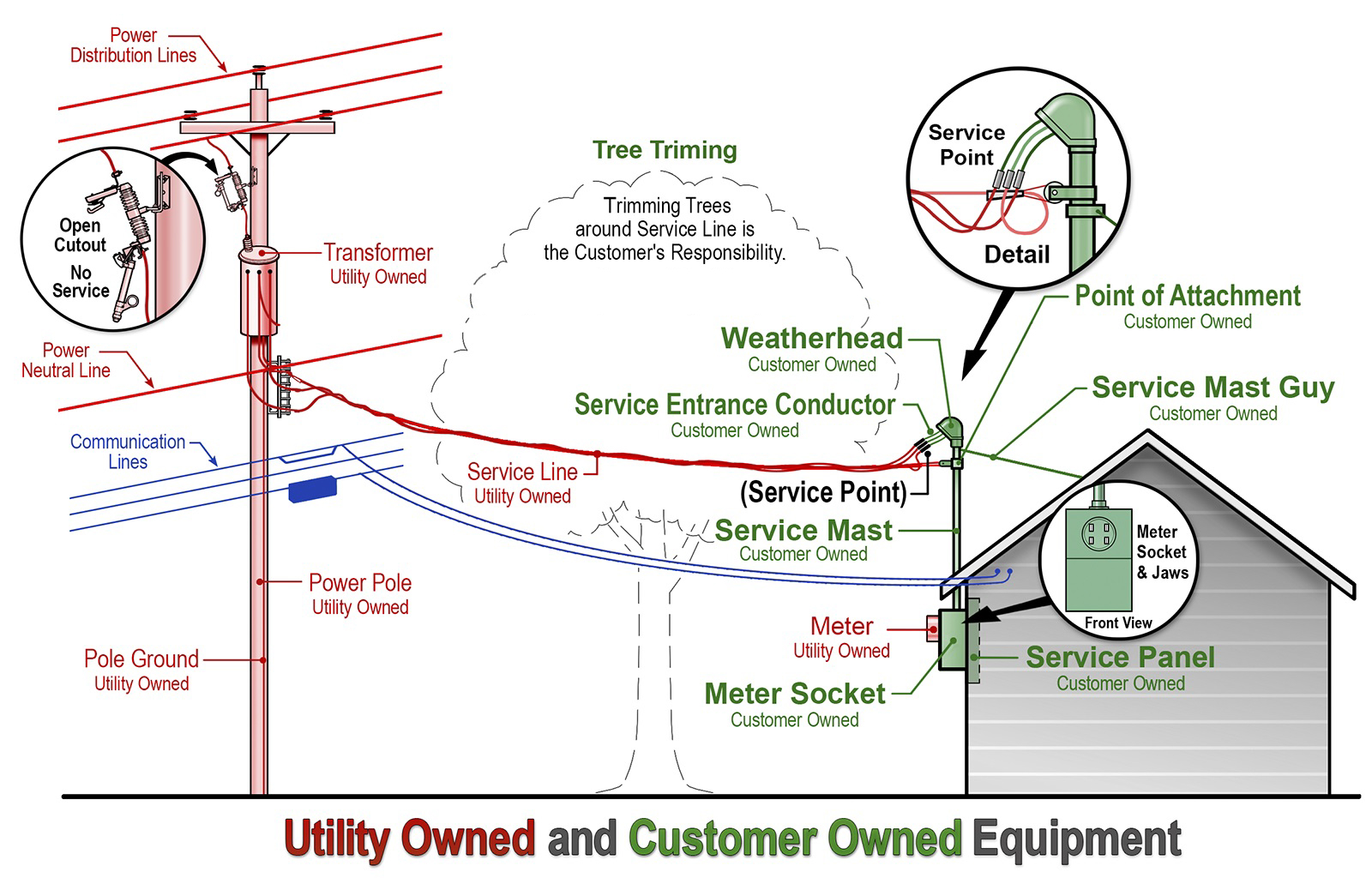
Utility-owned vs customer-owned equipment reference diagram.
The following are requirements of OSHA regulation sections 1926.416(a)(1) and 1926.1408(a)(2).
Protection of Employees
1926.416(a)(1): No employer shall permit an employee to work in such proximity to any part of an electric power circuit that the employee could contact the electric power circuit in the course of work, unless the employee is protected against electric shock by deenergizing the circuit and grounding it or by guarding it effectively by insulation or other means. (This requires a minimum clearance of ten feet for lines rated 50 kV or less, phase to ground.)
Power Line Safety (up to 350 kV)—Equipment Operations
1926.1408(a)(2): Determine if any part of the equipment, load line or load (including rigging and lifting accessories), if operated up to the equipment's maximum working radius in the work zone, could get closer than 20 feet to a power line. If so, the employer must meet the requirements in Option (1), Option (2), or Option (3):
- Option (1)—Deenergize and ground: Confirm from the utility owner/operator that the power line has been deenergized and visibly grounded at the worksite.
- Option (2)—20-foot clearance: Ensure that no part of the equipment, load line, or load (including rigging and lifting accessories) gets closer than 20 feet to the power line by implementing the measures specified in paragraph (b) of this section.
- Option (3)—Table A clearance.
Table A — Minimum Clearance Distances
| Voltage (nominal, kV, alternating current) | Minimum clearance distance (feet) |
|---|---|
| Up to 50 | 10 |
| Over 50 to 200 | 15 |
| Over 200 to 350 | 20 |
| Over 350 to 500 | 25 |
| Over 500 to 750 | 35 |
| Over 750 to 1,000 | 45 |
| Over 1,000 | (As established by the utility owner/operator or a registered professional engineer who is a qualified person with respect to electrical power transmission and distribution.) |
Note: The value that follows “to” is up to and includes that value. For example, “Over 50 to 200” means up to and including 200kV.
Customer/Contractor Responsibility
It is the responsibility of the customer/contractor to contact Minnesota Power to provide cover-up and to provide payment for the work requested, whether it is for residential service lines/equipment or commercial primary lines/structures. In accordance with NESC and OSHA work rules, insulating cover-up is installed to protect energized facilities from incidental contact.
The following charges apply for the installation of cover-up during normal working hours. The linear measurement is a point-to-point measurement along the span and is independent of the number of conductors covered. Ex: a 100' span of 3-phase primary with neutral and a 100' span of secondary triplex each have a linear measurement of 100'.
| Cover-Up Linear Distance | Charges |
|---|---|
| Less than 60' or one month | No charge |
| >60' or an extended duration of time | Estimate required* |
*Costs are estimated by a Distribution Service Representative or Engineer. In most cases, the estimate will be the actual cost. Increased charges may result from more complex installations. A site visit may be necessary to estimate additional charges.
To schedule or ask questions, call 218-720-2757 or 1-800-228-4966.
If power has been off for more than one year, Minnesota Power requires a licensed electrical contractor to inspect all customer-owned equipment and certify it is safe to energize. Minnesota Power does not inspect or repair customer-owned equipment. Additional steps may be required depending on how long the service has been disconnected and other site conditions.
Please contact Minnesota Power at newconstruction@mnpower.com or 1-877-535-0394 to verify the requirements for your service. The customer must also contact our Call Center at 1-800-228-4966 to establish an account for billing prior to being re-energized.
Required Documentation
To re-energize service, a licensed electrical contractor must either submit a Safe to Energize Form, letter, or email.
The letter or email must include:
- Electrical contractor's name, electrical license number, and contact information
- Service address
- Customer name
- A statement verifying they have inspected the electrical service, and it is safe to re-energize
- For any electrical work done that requires an electrical permit, the electrical permit number is required
How to Submit
Send contractor letters and electrical permit copies to Minnesota Power:
- Email: inspections@mnpower.com
-
Mail:
Minnesota Power
Attn: New Construction
3215 W Arrowhead Rd
Duluth, MN 55811
Review detailed meter socket and installation requirements based on your service type:
Application & Request Forms
- Form 2055 — Residential Distribution Subdivisions Agreement
- Form 6034b — New Development or Subdivision Application
- Form 6034c — Commercial Construction Request
- Form 6034d — Residential Construction Request
- Form 7137 - Residential Construction Request (Upgrade Existing Service)
- Form 7138 — Construction Request (OH/UG Relocation)
- Form 3659 — Electrical Utility Load Profile
- Form 6032 — Physical Disconnection
- Residential Construction Project Checklist
Meter Specifications
- Sample Meter Spec Sheet (48804-02nu)
- Customer Meter — 320 Amp
- MP Meter — 200 Amp
- Customer Structure-Mounted Self-Contained Meter
- Customer Structure-Mounted Self-Contained Meter — 320 Amp
- Customer Underground Meter — 320 Amp
- MP Underground Meter — 200 Amp
Metering Cabinets & Transition Enclosures
Padmount Clearance & Placement
- Padmount Clearance — Near Buildings
- Padmount Clearance — Near Windows
- Padmount Clearance — Near Air Intake
- Padmount Clearance — Fire Escape
- Padmount Clearance — Using Protective Barriers
- Protective Barrier Specifications
Transformer Specifications (kVA Ratings)
- Padmount Transformer Concrete Base Specification — 100–250 kVA Single Phase
- Three-Phase — 30–300 kVA
- Three-Phase — 500–2,500 kVA
Engineering Drawings & Technical Specs
- Short-Circuit Currents
- MN Power Drawings — EMI
- MNP CT8-4L (Rev. 7-6-12)
- MNP CT12-4L (Rev. 7-6-12)
- MNP SCC8-4CT (Rev. 7-6-12)
- MNP SCC10-4CT (Rev. 7-6-12)
- MNP SCC12-40CT (Rev. 7-6-12)
- MNP SCC16-40CT (Rev. 7-6-12)
Lighting



Questions?
Call us at 1-877-535-0394 or 218-355-2644, or email newconstruction@mnpower.com